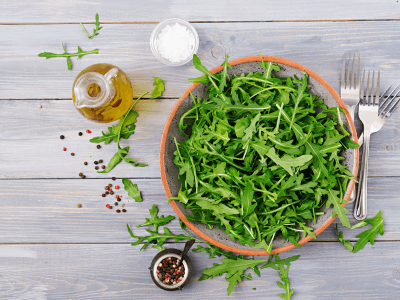
This week's CSA features Arugula from Bridgewater Farm in Bridgewater, IA. Did you know that Arugula was used as an aphrodisiac and often regulated in monasteries? OR that this leafy green is related to mustard? Neither did we! So we decided to take a dive into the history of this spicy green to share resources and a saucy recipe to get our taste buds ready for take off!
"The History of Arugula: Peppery Plant, Storied Past
By Michelle Johnson (from Rareseeds.com)
Fun Fact: Arugula is also often called rocket; both names derive from the original Latin name of the plant, “eruca.” As he was developing his botanical taxonomy, Carl Linneaus followed, naming arugula Eruca sativa.
Arugula: Origin and History
In Italy, where the plant never went out of fashion, regional dialects changed things a bit. In southern Italy it's called "aruculu" or "rucola." This became its most commonly used name in the United States, because most Italian immigrants to the states came from southern Italy. But in the north, it's known as "ruchetta."
This word, along with the crop itself, worked its way over the Alps, becoming "roquette" in French. The English embraced the plant, too, translating the French “roquette” to “rocket.” Rocket also has a wild, perennial relative, appropriately named Wild Rocket. It's a completely different genus and species, (Diplotaxis tenuifolia) but it's still a Brassica relative and has similar flavor to that of arugula, albeit even more piquant.
The Talmud recommends the plant for use as one of the "bitter herbs" (maror) of Jewish tradition. However, it is not to be eaten by high priests in the seven days leading up to Yom Kippur, on account of the belief that the plant would "foster impurity."
Arugula's reputation as an aphrodisiac wasn't limited to Western Asia. The Roman poet Virgil wrote "...et Venerem revocans eruca morantem..." which translated loosely means “The eruca revives drowsy Venus.” Nor is the belief entirely unfounded. According to a study published in 2013 in the journal of Al-Nahrain University, arugula leaf extracts boosted testosterone levels and sperm activity in mice.
The results suggest that the phytochemicals and/or nutrients in arugula may well have aphrodisiac properties. Its cultivation was certainly prohibited in many Medieval monasteries. Love potions included arugula and many other herbs such as lavender. Yet arugula was also reputed by the Romans to have anesthetic properties."
Watch "The Rise, fall, and return of Arugula to international cuisine" created by Britannica for a visual journey of this amazing plant's history.
Benefits of Arugula
It's high in B vitamins, especially folate, and also contains impressive amounts of vitamin C, vitamin A, vitamin K, calcium, potassium, magnesium, phosphorus, zinc, and iron. It's high in phytonutrients like isothiocyanates and carotenoids, yet it's lower in oxalic acid than spinach, purslane or mustard greens.
Its flavor is variously described as mustard-like, peppery, tart, bright, or bitter. While none of these descriptions really do it justice, most of us have tasted its complex flavor, if nowhere else than in salad mixes, where arugula has been making itself right at home since the first wave of foodie culture hit in the 1980s.
How to Cook Arugula?
Arugula earns its keep in so many dishes besides salads! It pairs well with meats and seafood. Toss fresh arugula, lemon zest, thyme, red pepper flakes and lemon juice with cooked chickpeas for a versatile side dish. Whip it into gazpacho or your favorite harissa recipe; blitz it into a pesto as the ancient Romans once did.
Arugula can even be included in soups or stews, or added to stir fry, whether Asian or Mediterranean inspired. Try it wilted into pasta dishes. And of course, incorporate arugula into salads, from a standard green one to one made with apple and raw parsnips."
Check out Rareseeds website to read the full article and learn more!
Watch the video to make Lemon Fusilli with Arugula with the Barefoot Contessa