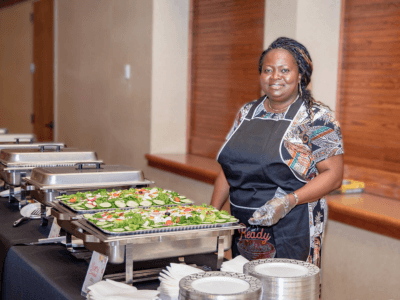
Most of Ines Dagnon’s business decisions happen between family responsibilities, event planning, and long days in the kitchen. Some weeks she’s cooking for large community events. Other weeks she’s turning down opportunities simply because she doesn’t have enough staff to say yes. Like many small business entrepreneurs, her challenge isn’t a lack of demand—it’s finding the time, systems, and support to grow sustainably.
Ines started Ready Délices by cooking for people she cared about, often undercharging, and learning through experience. Today, she’s building something more intentional: a food business rooted in culture, community, and a growing understanding of what it takes to make entrepreneurship sustainable.
Starting Before There Was a Business
Before there was a brand, a menu, or even a real sense of pricing, Ines was simply cooking. Friends, family, community events—if someone needed food, she showed up. At the time, she wasn’t tracking costs or calculating profit margins. She was buying ingredients out of pocket and charging what felt reasonable.
“Before, it was just cooking,” she says. “I’d buy the chicken and say, ‘Let’s charge you $200.’ You can’t run a business like that.”
It’s a familiar story for many food entrepreneurs. Skills and demand come first. Business systems come later—often after burnout, financial stress, or realizing that generosity alone doesn’t pay for ingredients, labor, or time.
Ines didn’t initially see herself as a business owner. She saw herself as someone who loved cooking and loved feeding people. But over time, it became clear that if she wanted to continue doing this work—especially at the scale people were asking for—she needed to treat it as a real enterprise.
That shift required new tools: budgeting, pricing, planning, and long-term thinking.
The Turning Point: Learning the Business Side
For Ines, one of the most important milestones was enrolling in Kauffman FastTrac, a nationally recognized entrepreneurship program offered through No More Empty Pots, focused on helping small business owners build sustainable models. The timing wasn’t ideal. Between family emergencies, travel, and caregiving, she missed several sessions. At one point, it felt almost impossible to continue, but “this is one of those programs you don’t want to miss,” she said.
For the first time, Ines had a written business plan. She had financial projections. She had something concrete she could use to make decisions, apply for opportunities, and communicate her vision. “We haven’t implemented everything yet,” she explains, “but at least we have it. We can say, ‘Next month we want to do this,’ and we have a starting point.”
That knowledge marked a turning point—from reacting to opportunities as they came, to intentionally building a business that could last.
Running a Food Business While Raising a Family
Ines’ business is deeply intertwined with her family life. She owns Ready Délices with her husband, and while much of the daily cooking and operations falls to her, the business is a shared commitment.
Her husband works as a military reservist, sometimes leaving for weeks or months at a time. During those periods, much of the responsibility—both at home and in the business—falls on her. Her daughter helps with flyers and menus, often using Canva to design promotional materials.
But as Ines jokes, her daughter is still a teenager. “She’ll start working, then her friends call and it’s, ‘Mom, I need to play Roblox, I’ll be back,’” she laughs.
Behind the humor is a real reality: for many small business owners, especially women, growth is limited not by talent or ambition, but by time, caregiving responsibilities, and the invisible labor that fills every day.
“The kids are growing, so it’s going to get better,” Ines says. “But right now, cooking is not a one-person business.” That truth shapes every decision she makes—from which events she accepts to how fast she wants to scale.
The Real Barrier to Growth: Staffing
Ask Ines what’s holding her back, and the answer is immediate: staffing.
“There are times I get orders, but I can’t do them,” she says. “Not because I don’t want to—but because I don’t have the people.”
She often prefers to cook everything herself. For her, quality control is personal. She wants to know what every dish tastes like before it goes out. That mindset creates a tension many founders face. Letting go of control is necessary for growth, but it’s also emotional. Food is personal. Recipes carry history, culture, and pride.
When she needs help, Ines sometimes hires culinary students or works with staffing agencies for event support. They help with prep, setup, cleanup, and service. She’s also built a strong partnership with another caterer she met through No More Empty Pots, Aminata Fall of Ami’s Kitchen. Because both are caterers, they understand each other’s challenges and often step in to help one another when schedules overlap or extra hands are needed.
It’s a practical compromise. It allows her to say yes to more opportunities without sacrificing standards, while slowly building the capacity to expand.
Community Kitchens Make Entrepreneurship Possible
“If I didn’t get into the kitchen here, the business wouldn’t even exist,” Ines says.
From her earliest festivals to large community events, No More Empty Pots provided the only affordable, consistent space where she could legally and safely prepare food. Without that infrastructure, she simply wouldn’t have been able to operate.
Today, No More Empty Pots remains central to her work. Even as she explores new partnerships and larger opportunities, the shared kitchen is still where everything comes together—planning, production, and problem-solving.
For many food entrepreneurs access to commercial kitchen space is one of the biggest barriers to entry. No More Empty Pots helps remove that barrier, turning ideas into businesses and skills into income.
Cultural Food as Community Impact
Ines’ food is about sharing culture. She regularly prepares African-inspired menus for community events, including large-scale collaborations like We Pitch Black, hosted by the Midlands African Chamber. For her, the work is about preserving and recreating the food she grew up with.
“There’s not a lot of African food here,” she explains. “So, I try to recreate the recipes I remember from home—the ones my mum used to make.” Her mother was a chef. When she comes to visit, they cook together, and she writes everything down.
African cuisine, she explains, is not one thing—it’s many. Recipes change by region, by family, and by season. The dishes she prepares today are shaped by what she remembers from home, what she learns from her mother, and what she adapts for the people she’s serving now.
Her menus often include dishes like jollof rice, grilled chicken with spiced sauces, stewed vegetables, and plant-based sides—food that feels familiar to her, but new to many of her customers.
At one event, she cooked for three days in collaboration with another chef who didn’t specialize in African cuisine. Together, they created a menu that introduced new flavors to a wider audience.
“We made this spicy sauce everyone still talks about,” she says.
Beyond revenue, moments like that build cultural visibility, pride, and representation, especially in a city where many cuisines remain underrepresented.
What Support Really Looks Like
When asked which resources have made the biggest difference, Ines doesn’t hesitate.
“No More Empty Pots is the biggest support we have.”
From kitchen access to business coaching to community connections, NMEP provided practical tools and emotional encouragement. Midlands African Chamber also played a key role, opening doors to new networks and events.
She’s now exploring opportunities for her own children, including programs like Rising CEOs, through the MAC Foundation, which teaches teenagers entrepreneurship and public speaking.
“I want my kids to see this,” she says. “To understand how businesses are built.”
That multi-generational impact—where one entrepreneur’s journey creates pathways for others—is exactly what community-based entrepreneurship ecosystems aim to support.
Advice for Other Food Entrepreneurs
Ines is honest about the challenges. The work is hard. The progress is not linear. Growth requires systems, not just talent.
“I’m glad I pushed through,” she says. “Even when it felt impossible.”
Her advice is simple but grounded in experience: don’t wait until everything is perfect. Seek out support. Learn the business side early. And accept that growth takes time.
Entrepreneurship, she believes, isn’t about overnight success. It’s about building something that fits your life, your values, and your capacity—then slowly expanding from there.
Looking Ahead
Ines’ story reflects the reality of many small food businesses: strong demand, limited capacity, and a deep desire to grow responsibly without losing quality or connection to community. Her journey highlights why access to shared kitchens, business education, and mentorship is necessary infrastructure for economic mobility.
Through No More Empty Pots, food entrepreneurs like Ines gain more than space. They gain systems, confidence, and the opportunity to transform informal labor into sustainable income.
Her business is still evolving. But one thing is already clear: with the right support, food entrepreneurship can be a path to personal success and community impact.
Connect with Ready Délices via email at readydelices@gmail.com or by phone at 402-880-8797. Learn more about No More Empty Pots and how we support local food entrepreneurs.