
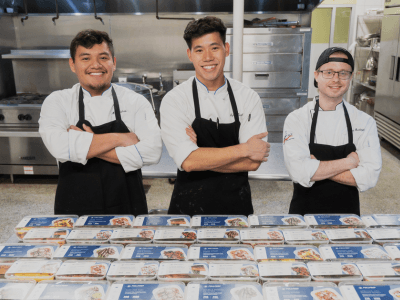
On weekday mornings, Tyler Hangley is already thinking in numbers—grams, portions, margins—long before most people are planning lunch. Before heading to his evening shifts as a chef at Happy Hollow Country Club, he spends time in the No More Empty Pots kitchen preparing scratch-made meals for customers across Omaha. Orders often come in with less than 24 hours’ notice, requiring careful planning, flexibility, and a system that leaves little room for error. For Tyler, the work is less about speed and more about doing things right—building a meal prep business where every decision has to make sense for the customer.
Six months after officially launching FullPrep Fitness Meal Prep, Tyler is building a meal prep business that prioritizes freshness, flexibility, and trust in an industry where shortcuts are common. The company doesn’t freeze meals. It doesn’t overstock inventory. And it doesn’t promise to serve everyone. Instead, FullPrep focuses on doing a few things well—clean, scratch-made meals designed for people with fitness goals.
What started as helping friends has grown into a company shaped by patience, planning, and a belief that putting customers first is not only the right thing to do, but the most sustainable path forward.
From Fitness Passion to Food Mission
Long before FullPrep launched, Tyler was already doing the work in an informal way. As a teenager, he helped friends with workout routines, meal plans, and accountability. He saw firsthand how consistent nutrition could support not just physical health, but confidence, mental clarity, and motivation.
While working at a manufacturing plant at 18 and 19 years old, he began cooking and portioning meals for friends—shopping for groceries, preparing food in his apartment, calculating macronutrients, and delivering meals himself. The process was time-consuming, but it revealed something important.
“I wouldn’t mind doing this as a job,” he remembers thinking.
At the time, Omaha had meal prep options, but none that fully aligned with the needs Tyler saw around him. He wasn’t interested in becoming a personal trainer, working for a supplement company, or following a conventional fitness-industry path. Food felt like the right medium—tangible, practical, and impactful.
That realization marked the moment when fitness and cooking came together as a single mission: helping people fuel their goals through food that was intentional, accessible, and well-made.
Four Years in the Making
Although FullPrep officially launched in July, the business itself was years in the making. Tyler first attempted to start the company in the fall of 2021, shortly after enrolling in culinary school. The name, target market, and general vision were there—but the model needed refinement.
Early testing focused on fully customized meal plans, designed around individual goals. While appealing in theory, the approach quickly proved difficult to scale. Fully custom meals added layers of complexity that made consistency, time management, and waste reduction challenging.
Rather than forcing growth too early, Tyler made a deliberate choice to pause. He focused on completing culinary school, gaining hands-on experience in professional kitchens, reading extensively about business and leadership, and observing how people interact with food—both inside and outside the fitness space.
“I just felt like it was the right thing to pause, get through school, and really learn the business before pushing forward,” he says.
That patience became a strength. By the time he graduated in early 2024, the service model was clearer, the vision more grounded, and the next steps realistic rather than rushed.
A Different Kind of Meal Prep Model
FullPrep Fitness Meal Prep operates with a streamlined menu built around two portion sizes—one for customers looking to lean out, and one for those focused on bulking up. Meals are designed with clean ingredients, balanced macronutrients, and consistent quality.
The food is made from scratch, never frozen, and prepared within a 24-hour window. Orders are accepted throughout the workweek, offering flexibility that many meal prep companies don’t provide. At the same time, FullPrep doesn’t operate on weekends, a decision Tyler made to protect both staff sustainability and long-term consistency.
There are trade-offs. The company pays more per ingredient because it doesn’t buy in bulk. It accepts the added cost in exchange for freshness. But those choices are intentional.
“There are just some things we’re not willing to compromise on,” Tyler explains. “We believe it’s better for the customer, and it’s what sets us apart.”
For customers, the benefit is clear: food that tastes good, fits their goals, and arrives when they need it—without having to plan a week in advance or sacrifice quality for convenience.
Precision, Planning, and Minimal Waste
Behind the scenes, FullPrep runs on systems designed to reduce guesswork. Tyler and his team rely on detailed spreadsheets that break down each menu item ingredient by ingredient, accounting for raw versus cooked weights and portion yields.
Each order is translated into an exact grocery list, allowing the team to purchase only what’s needed for that day or maintain carefully calculated par levels. The approach minimizes spoilage and keeps cash flow working for the business instead of sitting on shelves.
“Extra inventory is waste,” Tyler says. “Even if it’s shelf-stable, that money could be invested somewhere else.”
This operational discipline reflects a broader philosophy: sustainability isn’t just about growth, but about stewardship—of ingredients, time, and resources.
Building a Team Before It’s Comfortable
Six months into launch, FullPrep employs three team members—all connections Tyler made during culinary school. Rather than waiting until growth felt “safe,” he built with the long term in mind.
The team works under an equity-based model that prioritizes shared vision and buy-in over short-term convenience. While not majority partners, team members have a stake in the company’s future, reinforcing accountability and alignment.
“They’re sacrificing just as much as I am,” Tyler says. “They believe in where this is going.”
That trust has helped the business navigate rapid adjustments, operational pivots, and the realities of early-stage entrepreneurship—without losing momentum or morale.
Building Toward Long-Term Stability
Tyler is transparent about what FullPrep Fitness Meal Prep needs to become his full-time focus. He has set a benchmark for how many meals per business day, Monday through Friday, that will allow the company to sustainably replace his outside income.
It’s a realistic goal. Most customers order multiple meals at once, meaning the daily target could be met with as few as seven customers per day. Still, the path there requires careful cash flow management, especially when balancing labor, and ingredient costs.
“These are good problems to have,” Tyler says, acknowledging that growth brings its own challenges. “But we’re building toward something stable.”
Community Support and No More Empty Pots
Tyler’s journey with No More Empty Pots began years before FullPrep launched. As a culinary student exploring entrepreneurship, he connected with business coach Eric Purcell, now co-owner of Myrtle & Cypress Coffee House. That early mentorship helped him clarify his target market, value proposition, and long-term vision.
“Mentors are invaluable,” Tyler says. “That guidance stayed with me.”
Today, FullPrep operates out of the No More Empty Pots kitchen, benefiting from physical space and from a broader ecosystem of entrepreneurs, shared learning, and mutual support. For Tyler and his team, the environment feels welcoming and collaborative.
“I feel seen here,” he says. “People check in. They care about how the business is doing.”
That sense of belonging—combined with access to resources—has played a meaningful role in turning an idea into a viable operation.
Advice for Aspiring Food Entrepreneurs
When asked what advice he’d give to others considering a food business, Tyler returns to the same principle that shapes every part of FullPrep: put the customer first.
“Filtering decisions through what helps the customer most usually leads to the best outcomes,” he says. While financial pressure is inevitable, Tyler believes sustainability follows value—not the other way around.
“If you put the customer first, the money will follow.”
Looking Ahead
Six months in, FullPrep Fitness Meal Prep is still growing, adapting, and refining its systems. But its foundation is already clear: intentional food, disciplined operations, and a commitment to serving people well.
For No More Empty Pots, stories like Tyler’s reflect the broader impact of community-based entrepreneurship—where access to resources, mentorship, and shared space helps local businesses grow with integrity.
FullPrep’s journey is a reminder that building something meaningful doesn’t require rushing. Sometimes, it just requires doing the next right thing—consistently.
Learn more about FullPrep or explore entrepreneurship resources through No More Empty Pots.