This week’s CSA is featuring the Hakurei Turnip from Pekarek’s Produce in Dwight, NE. Turnips are a veggie we encounter in many spaces and many meals but the Hakurei turnip has a storied history that created the "lovely" turnip grown right here in Nebraska!!
General Information
Hakurei name meaning: The characters for Reimu's last name "博麗" (Romanized: Hakurei) literally means something like "esteemed companion", the first word "博" (Haku) means "wide" or "exposition" while "麗" (Rei) means "lovely", "graceful", and "beautiful."
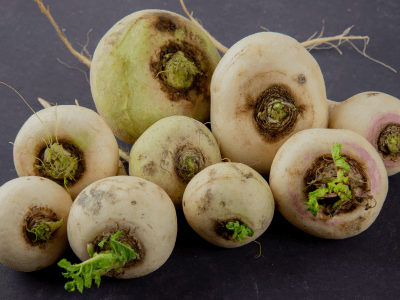
Like all turnips, the Hakurei, or Tokyo turnip is sometimes referred to as a salad turnip, due to its crisp, delicious raw flavor. Unlike other turnip varieties, hakurei do not need to be cooked. They have an even-textured density and the flavor pairs well with a variety of different food items. Eat them raw (just whole, or chopped/grated in salads), make a quick pickle, or cook with their greens to enhance their natural sweetness.
What Are They?
Also called salad turnips or Tokyo turnips, hakurei turnips are in the brassica family. They produce pearl-white roots, and narrow green leaves, both of which are edible.
As a category, turnips have a sad and storied link to food insecurity, having served as a subsistence crop across the globe throughout history. So significant was the role of turnips in Germany during World War 1, for example, that the winter between 1916 and 1917 was dubbed “The Turnip Winter.” Turnips were the only source of food for thousands of Germans after bad weather and diversion of agricultural resources to war efforts doomed that year’s potato crop.
The hakurei turnip was cultivated by seed breeders in the 1950s in Japan. During World War II, Japan experienced the greatest famine of any country involved in the conflict, and starvation and widespread rationing followed into the post war years. As Japanese agriculture picked back up, seed savers and breeders were prioritizing flavor and hardiness, and selected for a soft, salad-type turnip that would be easy to grow in a variety of zones. The resulting turnip, what we now refer to as the hakurei, took Japan by storm.
https://www.burkett.farm/stories/field-notes-hakurei-turnips
Storing & Cooking Information
Handling: Wash and peel the turnip root. Turnips should not be overcooked, or they will become dark in color and strong in flavor.
Storing: Turnips should be stored unwashed in plastic bag in hydrator drawer of the refrigerator. Store greens separately wrapped in damp towel or plastic bag - use them as soon as possible.
Freezing: Freeze turnips in cubes or fully cooked and mashed. Cut off tops, wash and peel. Cut in cubes to blanch or in large chunks to cook and mash before freezing. Cubes blanch in 2 minutes. To mash, cook in boiling water until tender. Drain, mash or sieve. Cool. Leave ½ inch headroom for either.
https://nesfp.nutrition.tufts.edu/world-peas-food-hub/world-peas-csa/produce-recipes/hakurei-turnips
3 WAYS TO PREPARE
Raw! Hakurei are wonderful raw. Serve them on a crudités plate, with a bit of oil and salt. They look like a radish, but are mild and sweet.
Grill it! Toss whole or halved Hakurei on a hot grill for a few minutes. They will soften a bit and the flesh will sweeten. They go with anything!
Sauté in brown butter with their greens. Halve or quarter the turnips, and chop the greens coarsely. Heat butter until it just starts to bubble and become fragrant, toss in the turnips, turning often, add the greens after a minute or two, and cook for an additional 4-5 minutes. Season with salt and pepper. Delicious and simple! Because of their high water content, cook Hakureis on high heat to encourage caramelization. https://cedarcirclefarm.org/tips/entry/hakurei-turnip-all-about-it
RECIPES
Maple Glazed Turnips & Carrots
Ingredients: Turnips, carrots, chicken stock, butter, maple syrup, black pepper.
Directions: Scrub and peel the turnips and cut into quarters or sixths, depending on their size. Slice the carrot at an angle into ½ inch-thick pieces. Put the vegetables and stock in a medium saucepan and bring to a boil. Cover and cook until the turnips are barely tender, about 7 minutes. Reduce the heat to medium-high and add the butter and maple syrup. Stir to coat the vegetables and continue to cook uncovered until the vegetables are glazed and beginning to caramelize around the edges, about 2 minutes. Season with salt and pepper and serve. https://nesfp.nutrition.tufts.edu/world-peas-food-hub/world-peas-csa/produce-recipes/maple-glazed-turnips-carrots
Pickled Hakurei Turnips
Ingredients: Hakurei turnips, salt, wine vinegar, sugar, black peppercorns, ginger.
Directions: Wash turnips well and slice them thinly (a mandolin works well if you have one). Place turnip slices in a small bowl and toss with the salt. Let rest until there is a pool of liquid on the bottom of the bowl, about 30 minutes. Drain turnips of the salty water and pack into a pint sized mason jar. Add vinegar, sugar, pepper and ginger slices. Apply a watertight lid and shake to combine. Place pickled turnips in the fridge and chill before eating. Pickles can be eaten within an hour of being made and will keep for at least a week. https://nesfp.nutrition.tufts.edu/world-peas-food-hub/world-peas-csa/produce-recipes/quick-pickled-hakurei-turnips
Hakurei Turnips in Mustard Sauce
Ingredients: Hakurei turnips, olive oil, chicken stock, cornstarch, Dijon mustard, parsley salt & pepper.
Directions: Place the oil in a large, deep skillet that can later be covered and turn the heat to medium. A minute later, add the turnips, salt, and pepper and cook, stirring occasionally, until the turnips begin to brown, about 10 minutes. Add the stock, cover, and simmer until the turnips are tender, 10 to 15 minutes. Remove the turnips to a serving bowl with a slotted spoon; keep warm. Mix the cornstarch into the mustard and stir the mixture into the pan juices. Cook over low heat until lightly thickened, a minute or two longer. Pour the sauce over the turnips, garnish, and serve.